
Encrypt vs Hash: What’s the Difference?
Table of Contents
- What Is Encryption?
- What Is Hashing?
- Key Differences Between Encryption and Hashing
- Encryption vs Hashing: When Should You Use Each?
- Why Password Hashing Matters
- Can Encryption and Hashing Be Used Together?
- Common Myths About Encryption and Hashing
- FAQs: Encrypt vs Hash
- Conclusion: Encrypt or Hash the Right Way
When dealing with passwords, sensitive data, or user authentication, many people confuse encryption and hashing. They sound similar, but they solve very different problems. Choosing the wrong one can expose data, break security best practices, or even lead to compliance issues. This guide clearly explains encrypt vs hash, how each works, when to use them, and common mistakes to avoid—so you can protect data correctly and confidently.
What Is Encryption?
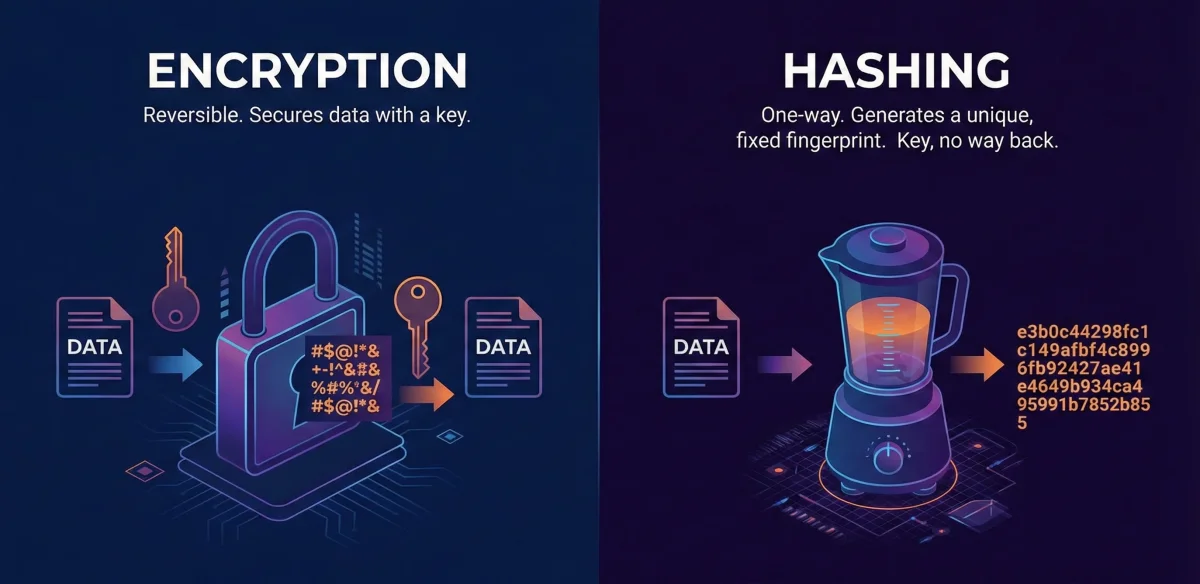
Encryption is a reversible process that converts readable data (plaintext) into unreadable data (ciphertext) using a secret key.
If you have the correct key, you can decrypt the data back to its original form.
How encryption works
-
Input: Plain data (text, files, messages)
-
Process: Encryption algorithm + secret key
-
Output: Ciphertext
-
Reverse possible: Yes (with the key)
Common use cases for encryption
-
Securing files and databases
-
Protecting data in transit (HTTPS, SSL/TLS)
-
Encrypting emails and backups
-
Storing sensitive personal or financial data
Popular encryption algorithms
-
AES (Advanced Encryption Standard)
-
RSA
-
ChaCha20
Encryption is ideal when data must be recovered later.
What Is Hashing?
Hashing is a one-way process that converts data into a fixed-length string called a hash.
Once data is hashed, it cannot be reversed back to the original value.
How hashing works
-
Input: Any data (password, text, file)
-
Process: Hashing algorithm
-
Output: Fixed-length hash
-
Reverse possible: No
Even a tiny change in input produces a completely different hash.
Common use cases for hashing
-
Storing passwords securely
-
Verifying file integrity
-
Digital signatures
-
Data comparison without revealing actual data
Popular hashing algorithms
-
bcrypt (recommended for passwords)
-
SHA-256 / SHA-512
-
SHA-1 (legacy, not recommended for security)
If you want to experiment, you can generate hashes using Toolszu’s online MD5 generator, SHA-1 generator, SHA-512 generator, or securely hash passwords with the bcrypt generator.
Key Differences Between Encryption and Hashing
Reversibility
-
Encryption: Reversible with a key
-
Hashing: Irreversible
Purpose
-
Encryption: Protect data while keeping it recoverable
-
Hashing: Verify or store data without ever revealing it
Security risk if leaked
-
Encryption: High risk if the key is compromised
-
Hashing: Lower risk (especially with salted hashes)
Typical example
-
Encryption: Credit card data
-
Hashing: User passwords
Encryption vs Hashing: When Should You Use Each?
Use encryption when
-
You need to read the data later
-
Data must be shared securely
-
Regulatory compliance requires data recovery
Examples: medical records, invoices, private files
Use hashing when
-
You only need to verify data
-
You never want the original value back
Examples: login passwords, API keys, file checksums
A classic mistake is encrypting passwords instead of hashing them. Passwords should always be hashed, preferably with bcrypt or similar slow hashing algorithms.
Why Password Hashing Matters
Storing passwords in plain text or encrypted form is dangerous. If attackers gain access, encrypted passwords can be decrypted.
Hashed passwords cannot.
Modern best practices recommend:
-
Strong hashing algorithm (bcrypt, Argon2)
-
Unique salt for each password
-
Adequate cost factor (slows brute-force attacks)
According to guidance from NIST and OWASP, password hashing is essential for modern application security.
Can Encryption and Hashing Be Used Together?
Yes.
A common pattern:
-
Encrypt sensitive data (like personal details)
-
Hash authentication data (like passwords)
They are not competitors. They solve different security problems and often work together in secure systems.
Common Myths About Encryption and Hashing
“Hashing is just weak encryption”
False. Hashing is intentionally one-way.
“Encrypted passwords are safe enough”
False. If decrypted, all passwords are exposed.
“MD5 is secure”
False. MD5 and SHA-1 are broken for security-sensitive use.
FAQs: Encrypt vs Hash
Is hashing safer than encryption?
For passwords, yes. Hashing is safer because it cannot be reversed.
Can hashed data be decrypted?
No. Hashing is a one-way process.
Should I encrypt user passwords?
No. Passwords should always be hashed, not encrypted.
What is the best hashing algorithm for passwords?
bcrypt (or Argon2) is widely recommended.
Can I hash files and text online?
Yes. You can use tools like an online MD5 generator or SHA-512 generator for non-sensitive checks.
Conclusion: Encrypt or Hash the Right Way
Encryption and hashing are both essential—but for different reasons.
Use encryption when data must be recovered. Use hashing when data must be verified but never revealed.
Understanding this difference helps you build safer applications, protect user trust, and avoid costly security mistakes.
If you want to test or understand hashing in practice, explore Toolszu’s secure online hash generators and see how these concepts work in real time.