Toolszu

Follow Us

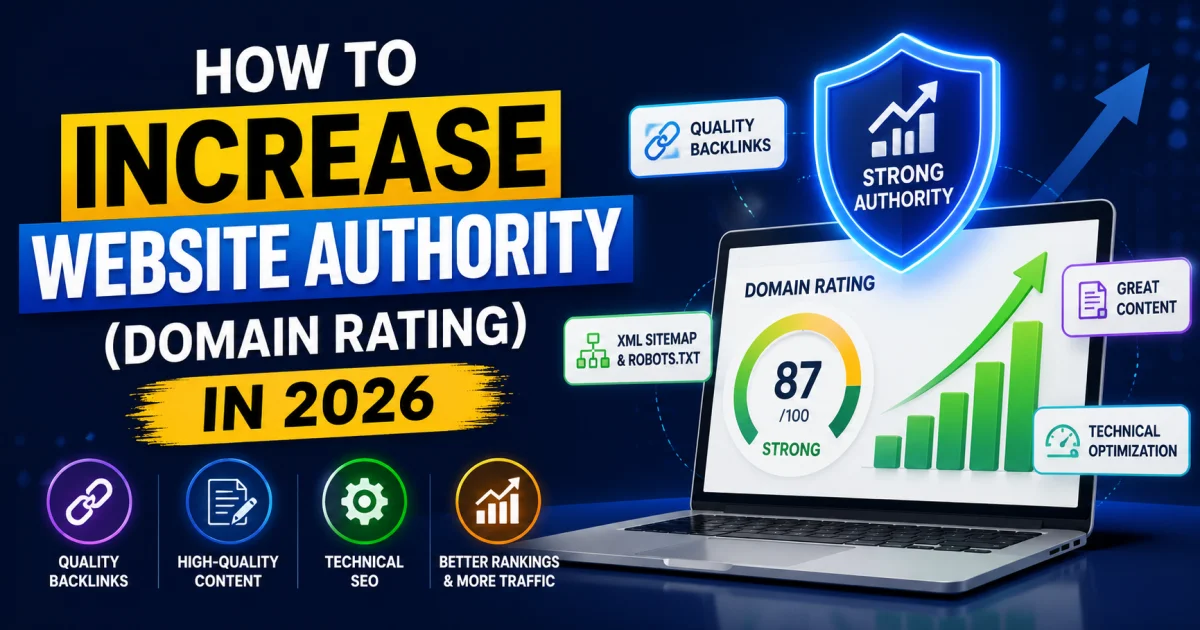
Website authority and Domain Rating SEO guide showing website audit, backlink analysis, XML sitemap, robots.txt, and technical SEO tools for improving search rankings in 2026.

How to Increase Website Authority (Domain Rating) in 2026

Updated: Jul 26, 2026 20 views

Building a website is easier than ever, but earning authority in search engines is still one of the biggest challenges. Whether you're a blogger, business owner, or digital marketer, improving your website's Domain Rating (DR) and overall authority can help you rank higher, attract quality backlinks, and increase organic traffic. While there is no shortcut to a high Domain Rating, following proven SEO practices consistently can make a significant difference. In this guide, you'll learn practical strategies to improve your website's authority in 2026 and the tools that can help you measure and optimise your progress.

What Is Website Authority (Domain Rating)?

Website authority is a measure of how trustworthy and influential a website appears based on factors such as backlinks, content quality, technical SEO, and user experience.

Domain Rating (DR), developed by Ahrefs, is one popular metric that estimates the strength of a website's backlink profile. Although Google does not use DR as a ranking factor, websites with stronger backlink profiles often perform better in search results.

Instead of chasing a higher score, focus on building a website that deserves links and provides real value to users.

Start by Auditing Your Website

Before improving authority, understand your website's current strengths and weaknesses.

A complete audit helps identify:

  • Broken pages
  • Missing meta tags
  • Slow-loading pages
  • SEO issues
  • Mobile usability problems
  • Internal linking opportunities

You can begin with a comprehensive website reviewer to identify technical and on-page SEO improvements that may affect your search performance.

Monitor Your Domain Rating

Tracking progress helps you understand whether your SEO efforts are working.

Using a Domain Rating Checker allows you to monitor changes in your website's authority over time and compare your site with competitors.

Remember that increasing Domain Rating is a long-term process. Consistency matters more than quick wins.

Publish High-Quality Content That Earns Links

Content remains one of the strongest drivers of authority.

Create articles that solve real problems rather than targeting keywords alone.

Examples include:

  • Ultimate guides
  • Original research
  • Industry statistics
  • Tutorials
  • Case studies
  • Free tools
  • Templates and checklists

When your content becomes genuinely useful, other websites naturally reference and link to it.

Google's Search Central documentation recommends creating helpful, people-first content instead of writing solely for search engines.

Backlinks remain one of the strongest indicators of website authority.

However, quality matters far more than quantity.

Good backlink opportunities include:

Guest Posting

Write valuable articles for reputable websites in your niche.

Digital PR

Publish original data, tools, or research that journalists and bloggers want to reference.

Resource Pages

Many websites maintain lists of useful resources and tools. Reach out if your content provides genuine value.

Broken Link Building

Find broken outbound links on relevant websites and suggest your content as an alternative.

Avoid purchasing backlinks or participating in link schemes, as these can violate Google's spam policies.

Improve Technical SEO

Even excellent content can struggle if search engines cannot crawl your website efficiently.

Create an XML Sitemap

An XML sitemap helps search engines discover important pages more efficiently.

Generate one easily using the XML Sitemap Generator and submit it through Google Search Console.

Optimise Your Robots.txt File

A properly configured robots.txt file tells search engine crawlers which pages should or should not be crawled.

You can quickly create one with the Robots.txt Generator.

Improve Site Speed

Fast websites provide a better user experience and encourage visitors to stay longer.

Focus on:

  • Compressing images
  • Reducing JavaScript
  • Enabling browser caching
  • Using a CDN
  • Choosing reliable hosting

Strengthen Your Internal Linking

Internal links help search engines understand your website structure while distributing authority across pages.

Instead of adding random links, connect related articles naturally.

For example, if you publish guides about SEO tools, audits, or technical optimisation, link between those pages where relevant. Strong internal linking also helps visitors discover more useful content.

Optimise for User Experience

Search engines increasingly reward websites that provide a positive experience.

Pay attention to:

  • Mobile responsiveness
  • Clear navigation
  • Readable typography
  • Fast loading times
  • Helpful content
  • Secure HTTPS connections

Visitors who stay longer and engage with your content send positive quality signals over time.

Be Consistent With Content Publishing

Authority isn't built overnight.

Publishing one excellent article every week is usually more effective than publishing twenty low-quality posts in a single month.

Create a realistic content schedule and focus on:

  • Updating older articles
  • Adding new statistics
  • Refreshing screenshots
  • Expanding thin content
  • Answering emerging user questions

Fresh, accurate content has a better chance of attracting backlinks naturally.

Common Mistakes That Hurt Domain Rating

Many website owners unknowingly slow their progress.

Avoid these common mistakes:

  • Buying low-quality backlinks
  • Publishing AI-generated content without editing
  • Ignoring technical SEO
  • Creating duplicate content
  • Neglecting internal links
  • Publishing thin articles with little value
  • Chasing Domain Rating instead of helping users

Long-term authority comes from trust, not shortcuts.

Frequently Asked Questions

Does Google use Domain Rating as a ranking factor?

No. Google does not use Domain Rating directly. It is a third-party metric that estimates backlink strength, but improving the factors behind it often supports better SEO performance.

How long does it take to increase Domain Rating?

It depends on your backlink profile, content quality, and competition. Most websites see gradual improvements over several months of consistent SEO work.

Are backlinks still important in 2026?

Yes. High-quality, relevant backlinks remain one of the strongest signals of authority, although content quality and user experience are equally important.

Should I focus on Domain Rating or organic traffic?

Organic traffic should be your primary goal. A higher Domain Rating is helpful, but attracting qualified visitors who engage with your content is ultimately more valuable.

How can I improve my website's technical SEO?

Start by auditing your website, creating an XML sitemap, configuring a robots.txt file correctly, improving page speed, fixing crawl errors, and ensuring your website is mobile-friendly.

Conclusion

Increasing your website's authority in 2026 requires patience, consistency, and a user-first mindset. Rather than focusing solely on Domain Rating, invest in creating valuable content, earning quality backlinks, strengthening technical SEO, and improving the overall experience for your visitors.

By regularly auditing your website, monitoring your progress, maintaining a healthy site structure, and publishing genuinely useful content, you'll build lasting authority that supports higher search rankings and sustainable organic growth. Focus on long-term improvements, and your website will continue to gain trust from both users and search engines.


Share this article